Rwanda wrapped up a nationwide campaign to court future issuers and widen financial-market participation, capping a months-long effort aimed at pulling more private companies into equity and debt financing as the country pursues long-term, self-sustaining economic growth.
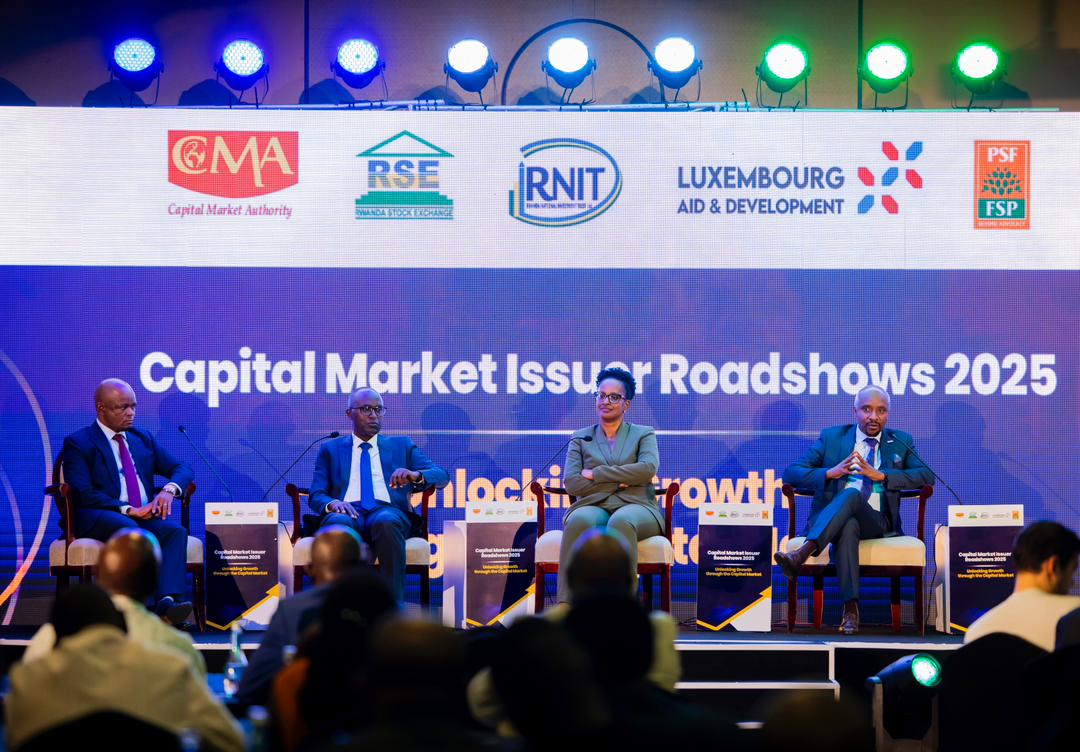
The Capital Market Issuer Roadshows 2025, led by the Capital Market Authority in partnership with the Rwanda Stock Exchange, Rwanda National Investment Trust and the Private Sector Federation, reached more than 700 enterprises across all provinces and Kigali. The push targeted SMEs, cooperatives and prospective issuers that have had limited exposure to formal capital-raising avenues.
“We set out to bring capital market opportunities to every part of Rwanda, and we achieved that,” Capital Market Authority Chief Executive Officer, Thapelo Tsheole said. “This effort represents the beginning of a wider strategy to extend financial participation and stimulate enterprise development through local markets,” Tsheole added.
The outreach sought to demystify instruments such as corporate bonds, commercial paper, listings and specialized investment vehicles, strengthening the country’s private-sector financing options.
Private Sector Federation CEO Stephen Ruzibiza said capital markets offer “patient, long-term capital that comes in as a partner, not only as a lender,” helping companies expand and diversify away from traditional bank borrowing.
Institutional investors say a shift in savings culture will be central to Rwanda’s ambitions. “Increased saving drives domestic investment,” Rwanda National Investment Trust CEO Jonathan Gatera said.
“That change in behavior is fundamental to building sustainable financial capacity.” He added that pension funds, unit trusts and other pooled schemes will anchor long-term market growth.
Rwanda Stock Exchange CEO Pierre Celestin Rwabukumba said the benefits of public markets go beyond fundraising. “A public listing provides not just funding, but structure, discipline, and visibility. For ambitious companies, it is a strategic evolution,” he said.
Corporates already in the market say the gains are tangible. “We are living proof that the market works,” Chairperson of Grain Millers Plc, Chantal Habiyakare said. “Going public helped us grow, formalize operations, and compete more effectively. It changed how we operate for the better.”
Government officials say the roadshows align with Rwanda’s broader push for financial sovereignty. “We have laid the foundation. The next step is to build an economy in which our own markets finance our own development. This is about sustainability and shared prosperity,” Director General of Capital Markets and Investment Schemes at the Ministry of Finance and Economic Planning Steven Biganiro said.
While the awareness drive has ended, regulators and industry leaders say the underlying agenda continues. With local firms increasingly exploring market-based financing and international investors seeking exposure to frontier economies, Rwanda is positioning itself to build a more liquid, transparent and inclusive financial system.