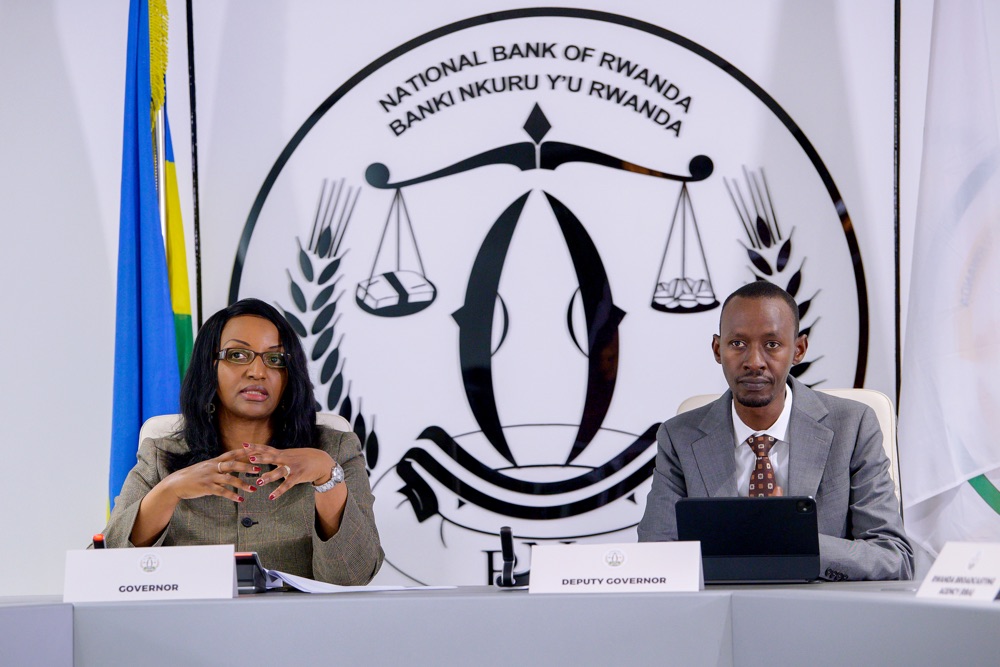
Rwanda’s central bank warned the franc could face renewed pressure in the second half of the year as the Middle East conflict threatens export earnings and drives up the cost of imported fuel and commodities, even as policymakers defended a surprise interest-rate increase aimed at containing inflation.
National Bank of Rwanda Governor Soraya Hakuziyaremye said weakening tea and coffee prices, alongside disruptions in key export markets such as the United Arab Emirates, could weigh on Rwanda’s external position later this year.
“It’s accurate to say that there’s likely to be exchange-rate pressures in the second half of 2026,” Hakuziyaremye told reporters in Kigali after the central bank raised its benchmark lending rate by 100 basis points to 8.25 percent.
The governor said the anticipated pressure stems from rising import costs linked to higher oil, gas and freight prices, as well as weaker export receipts from Rwanda’s traditional commodities.
Arabica coffee prices are projected to decline this year, while tea prices are also expected to weaken, potentially affecting foreign-currency inflows at a time when global trade routes remain disrupted by geopolitical tensions.
Still, Hakuziyaremye said Rwanda entered the latest external shock from a stronger position than in previous episodes, pointing to the recent stabilization of the franc and the country’s foreign-exchange reserves.
“We are confident that the funds that we have are adequate reserves,” she said, adding that Rwanda continues to maintain the international benchmark of reserves sufficient to cover four months of imports.
The central bank’s latest tightening move follows an acceleration in inflation driven by fuel costs, transport prices and supply-chain disruptions tied to the Middle East conflict.
Policymakers have now raised rates three times in less than a year, following a 25-basis-point increase in August last year and a 50-basis-point move in February.
Hakuziyaremye said the larger adjustment reflected a worsening inflation outlook and the need to prevent price pressures from becoming entrenched across the economy.
“The monetary policy reacts to how far inflation and inflation projections move,” she said. “Inflation projections have been revised at this time, and the monetary policy stance had to be adjusted by more than usual to make sure that inflation will come down quickly.”
The central bank forecasts average inflation of 13.9 percent this year before easing toward its 5 percent target over the medium term.
Officials argued that allowing inflation to remain elevated for a prolonged period would ultimately inflict more damage on businesses and households than tighter monetary policy.
Deputy Governor Nick Barigye said the rate increase was intended primarily to protect consumers from the erosion of purchasing power.
“This decision is being taken to protect Rwandans’ purchasing power, because inflation erodes purchasing power,” Barigye said.
He described the rate increase as a “measured step” based on global, regional and domestic economic assessments, adding that Rwanda’s financial system remained liquid, resilient and capable of continuing to finance private-sector activity despite tighter monetary conditions.
The comments come as Rwanda’s economy continues to post strong growth despite mounting external risks. Gross domestic product expanded 9.4 percent in 2025, with the final two quarters recording double-digit growth of about 11 percent, according to the central bank.
Hakuziyaremye said indicators for the first quarter of 2026 also point to continued strong expansion across services, manufacturing and transport.
But she acknowledged that businesses, particularly in manufacturing and transport, are likely to face rising production costs because of higher energy prices, freight costs and fertilizer expenses.
“We have to be very realistic on the increase in cost of production for the private sector,” she said.
The governor warned that the worst-case scenario would be a prolonged period of double-digit inflation that undermines investor confidence and weakens domestic demand.
“When investors see that, on the fiscal side but also monetary-policy side, we are still committed to price stability, this gives confidence on handling that inflation and being able to support the private sector,” she said.
The central bank said future policy decisions would depend on incoming inflation data and revised forecasts, signaling policymakers remain prepared to tighten further if price pressures intensify.