By Aby Agina
Kenyan President William Ruto challenged the country’s banking industry to convert recent gains in financial stability into cheaper and more accessible credit, saying high borrowing costs continue to constrain investment, entrepreneurship and job creation.
Ruto said banks need to do more than maintain strong balance sheets, urging lenders to channel the country’s savings into productive sectors including agriculture, manufacturing, infrastructure, technology and exports.
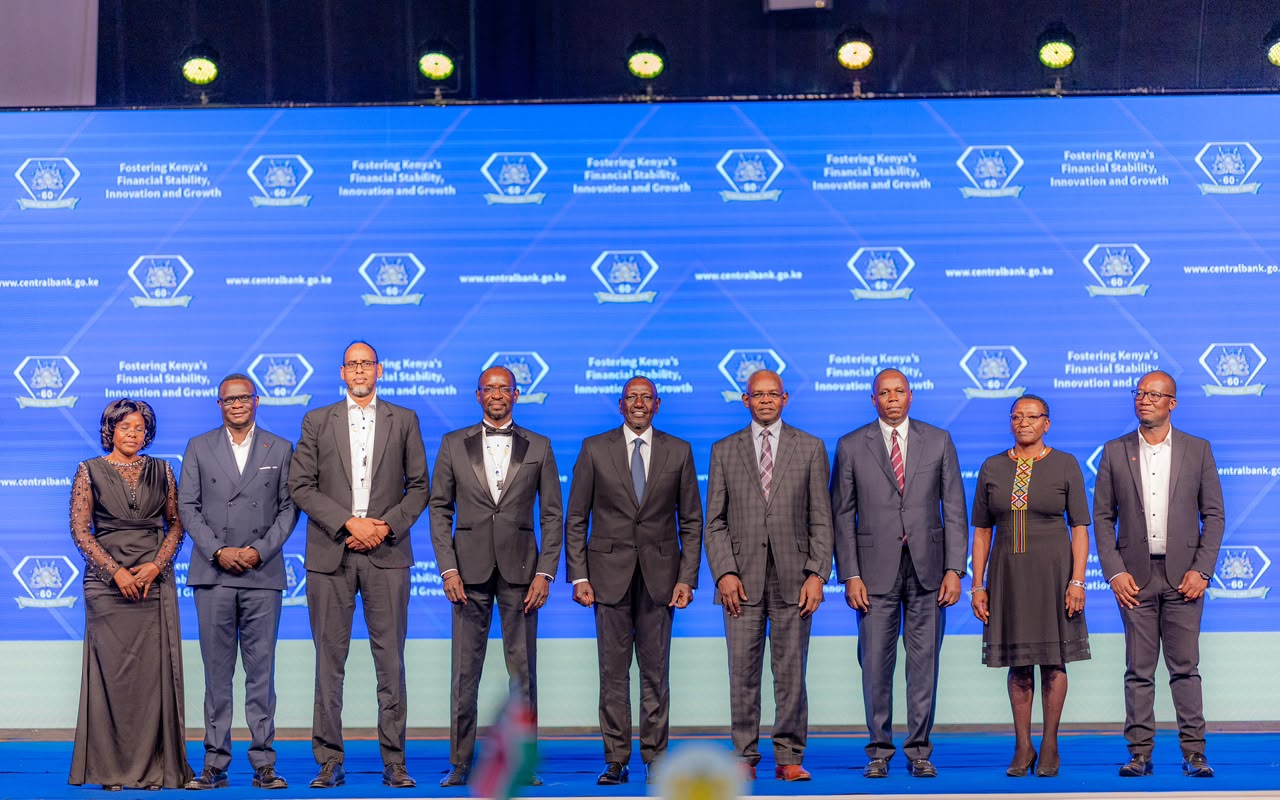
“Kenya does not need strong banks merely for the sake of having strong banks. We need strong banks capable of financing a strong economy,” Ruto said Thursday evening at celebrations marking the 60th anniversary of the Central Bank of Kenya in Nairobi.
The president said lending rates had declined to 14.39 percent in July, but remained prohibitively expensive for many households and businesses. He called on financial institutions to broaden access to credit, particularly for small businesses and ordinary Kenyans.
“Our financial institutions must become better at converting Kenyan savings into Kenyan production, including financing farms and factories, businesses and infrastructure, technology, exports, and enterprises,” he said.
Ruto’s comments put the spotlight on the next phase of Kenya’s economic recovery after a period of intense inflation, currency pressure and debt-financing challenges. He recalled taking office in September 2022 as the economy faced soaring food and energy prices, a weakening exchange rate and major external debt maturities.
He credited the Central Bank of Kenya with helping restore stability through tighter monetary policy as inflation and exchange-rate pressures intensified, while the government pursued fiscal and structural measures to address external financing pressures, including the 2024 Eurobond maturity.
“The Central Bank tightened monetary policy as inflation and exchange rate pressures intensified. Government confronted external financial challenge, including the 2024 Eurobond maturity, while pursuing fiscal and structural measures to strengthen the economy,” Ruto said.
The president said the central bank’s response demonstrated the importance of independent institutions during periods of economic stress, describing the CBK’s autonomy as a foundation of Kenya’s economic resilience.
“Strong institutions matter most when circumstances are difficult. The independence of the Central Bank is therefore not an abstract constitutional principle. It is Kenya’s economic strength,” he said.
The focus on credit costs comes as policymakers seek to ensure that improved macroeconomic stability feeds through to businesses and households. Ruto said financial stability should ultimately support greater economic opportunity, stronger enterprises and improved livelihoods.
The president also called for deeper financial integration across Africa, saying the continent has substantial pools of capital that could be mobilized to finance development.
Africa holds about $4 trillion in financial assets across banks, pension funds, insurance companies and capital markets, according to Ruto. Greater integration would allow the continent to deploy more of those resources toward its own development while maintaining links with global markets.
“Our ambition is not to retreat from the global economy, but to engage it from a position of greater financial strength while mobilizing more of our own capital for our own development,” he said.
The remarks were made in the presence of CBK Board Chairman Andrew Musangi, Governor Kamau Thugge, Association of African Central Banks Chairman Yvon Sara Bangui, members of the diplomatic corps and senior government officials.
About the Author: Aby Agina is a former CNBC journalist with extensive experience covering business, finance and economic affairs”