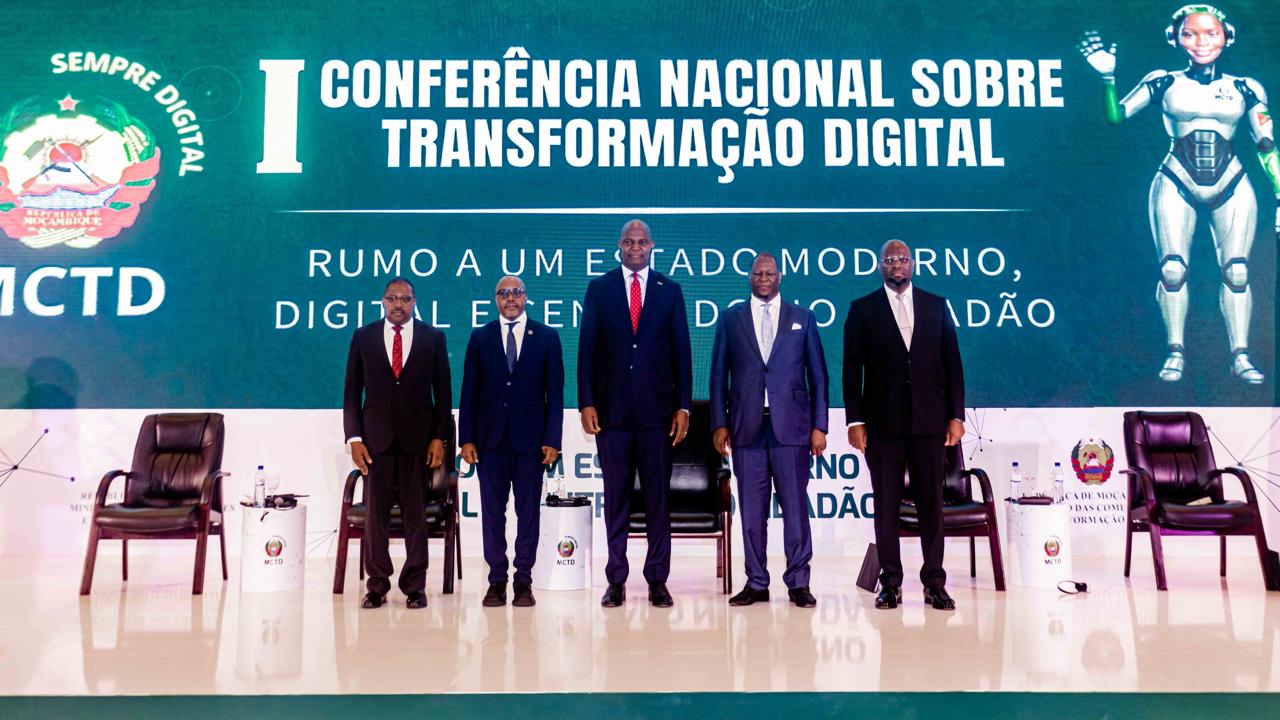
Mozambique has unveiled a nationwide digital integration drive aimed at overhauling public administration, reducing bureaucratic friction and strengthening its investment climate, in what President Daniel Francisco Chapo described as a structural reform of the State rather than a technology upgrade.
Speaking at the country’s First National Conference on Digital Transformation in Maputo, President Chapo cast digitalization as central to governance and sovereignty. “Countries are not transformed only with physical infrastructure. They are also transformed through digital infrastructure that connects citizens to the State and to opportunity,” The President said.
At the core of the initiative is the creation of a Multi-Sector Technical Commission on Digital Services tasked with delivering, by mid-2026, a national roadmap to integrate government systems. The commission will map existing digital platforms, promote interoperability across institutions, eliminate duplication and define a unified national integration strategy.
Mozambique’s public administration has long operated through fragmented databases and non-communicating systems, generating delays and administrative burdens for citizens and businesses. “There must be no technological islands within the State,” President Chapo said, acknowledging the inefficiencies created by institutional silos.
The government plans to enable citizens and companies to access identity documentation, licensing, tax payments and business registration remotely through interoperable systems and a centralized Citizen Portal.
Officials argue that digital integration could cut processing times, enhance transparency and improve Mozambique’s standing with investors as it seeks deeper private-sector participation and alignment with regional digital trade frameworks under the African Continental Free Trade Area.
Institutionally, the administration has already consolidated its agenda by establishing a dedicated Ministry of Communications and Digital Transformation, signaling that digital policy will sit at the core of economic management rather than on the periphery of IT modernization.
The announcement comes as Mozambique confronts heightened climate risks, including recent floods that disrupted several provinces.
The President linked digital reform to disaster resilience, emphasizing the role of early-warning systems, digital coordination platforms and secure preservation of administrative records. Without digital systems, he warned, governments weaken their ability to alert citizens in time and safeguard institutional continuity during natural disasters.
Beyond efficiency and resilience, the President framed the agenda in geopolitical terms. “Yesterday, independence was measured by control of territory. Today, it is also measured by the ability to govern the digital space,” he said, positioning data governance and cybersecurity as pillars of national sovereignty.
The ambition is to create what officials describe as a State “one click away” from citizens, accessible domestically and to Mozambicans abroad, while reinforcing cybersecurity and data-protection frameworks.
Execution, however, will determine whether the vision translates into structural change. Mozambique faces constraints including uneven internet penetration, rural connectivity gaps, and limited cybersecurity capacity and financing requirements for infrastructure upgrades. Institutional coordination across ministries, a persistent challenge in many emerging markets, will also shape the pace of implementation.
The Maputo conference gathered policymakers, financial institutions, academics and international partners, whose consultations are expected to inform the commission’s roadmap due by mid-2026. If delivered as planned, the reform could reposition Mozambique not only as a digitally integrated administration, but also as a more competitive participant in Africa’s evolving digital economy.