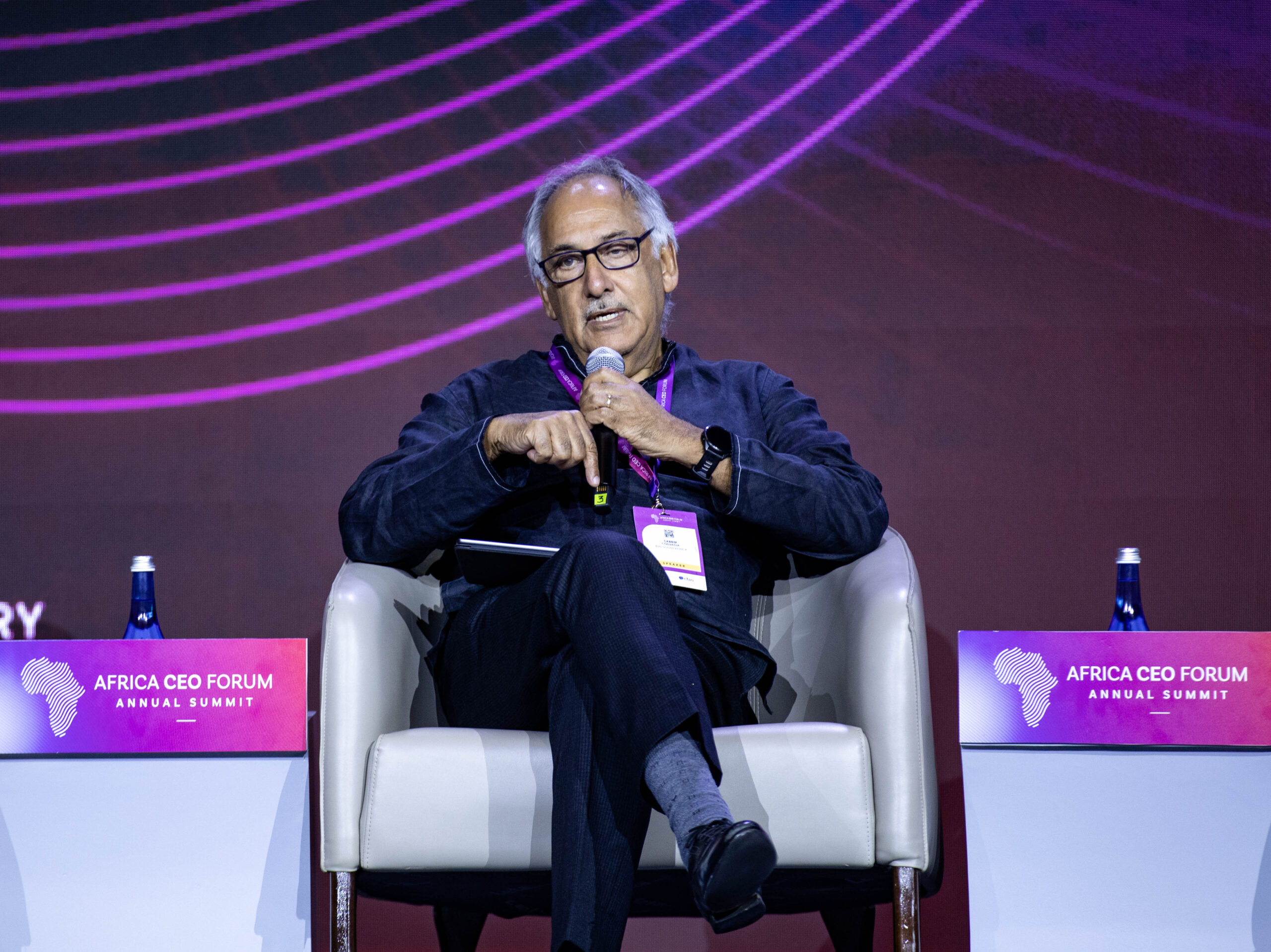
At the African CEO Forum in Kigali, Cassim Coovadia said African governments and businesses must forge deeper partnerships, harmonize investment rules and industrialize the continent’s raw materials sector if Africa is to compete for global capital amid rising trade fragmentation and slowing global growth.
Coovadia, speaking on the sidelines of the forum, said South Africa remains a key gateway for investment into Africa because of its diversified economy, but warned that the continent’s growth story increasingly depends on the strength of multiple regional economies rather than a single dominant market.
“While South Africa is the most diversified economy and has the resources and capability to be a gateway, many countries on the continent are, in their own right, investable and are popular,” Coovadia said.
The comments come as African economies race to attract manufacturing, green energy and digital infrastructure investment while global companies rethink supply chains and resource security. Governments across the continent are also seeking to position themselves as beneficiaries of the energy transition rather than exporters of raw minerals.
Coovadia said investor confidence would depend less on incentives and more on governments creating predictable environments for long-term capital deployment.
“Governments need to understand that the most critical and productive role they can play is to actually create the environment for businesses to invest and be profitable,” he said.
He argued that Africa must pursue both continental coordination and country-specific reforms, noting that the continent’s 54 economies operate under widely different regulatory and investment conditions. Greater collaboration through the African Continental Free Trade Area could help countries build regional industrial value chains instead of competing in isolation, he said.
Drawing comparisons with Europe’s aerospace industry, Coovadia said African economies should replicate collaborative manufacturing models where countries specialize in different stages of production.
“The Airbus is built in about six countries in Europe,” he said. “One country takes one component, another takes another component, and then one country assembles it all. That’s the sort of mindset we should have.”
He added that African governments and the African Union should establish common rules to prevent external powers from continuing to extract minerals without local processing and industrial development.
“We need to set some ground rules so that countries compete within that framework and we don’t have countries coming in and dictating to us how they will relate to us and continue taking our minerals and resources out without beneficiation,” Coovadia said.
Infrastructure financing and perceptions of risk remain among the biggest barriers to attracting long-term investment into Africa, according to Coovadia, who said international investors often overstate the continent’s risk profile despite evidence of strong returns.
“One of the critical areas is the perception investors have about risk on the continent,” he said. “That perception is incorrect. It’s not backed up by data.”
He said governments and businesses must jointly challenge risk narratives and push ratings agencies to reassess how African economies are evaluated. Stable legislation and regulatory consistency would also be critical for attracting capital into infrastructure and industrial projects that require long-term certainty, he said.
Coovadia said B20 South Africa had introduced a dedicated industrialization and transformation task force to focus on ensuring African economies capture more value from their mineral wealth and energy resources.
“It is absolutely critical for African countries to utilize the raw material resources and beneficiate those instead of just exporting the raw material and minerals,” he said.
He said Africa’s next phase of growth would depend on whether governments can create the legislative conditions needed for companies to manufacture competitively on the continent and export finished goods globally.
“We need to reindustrialize the continent,” Coovadia said. “We need to look at the competitive advantages different countries have in localization and beneficiation and create an environment that allows finished goods to be exported competitively.”