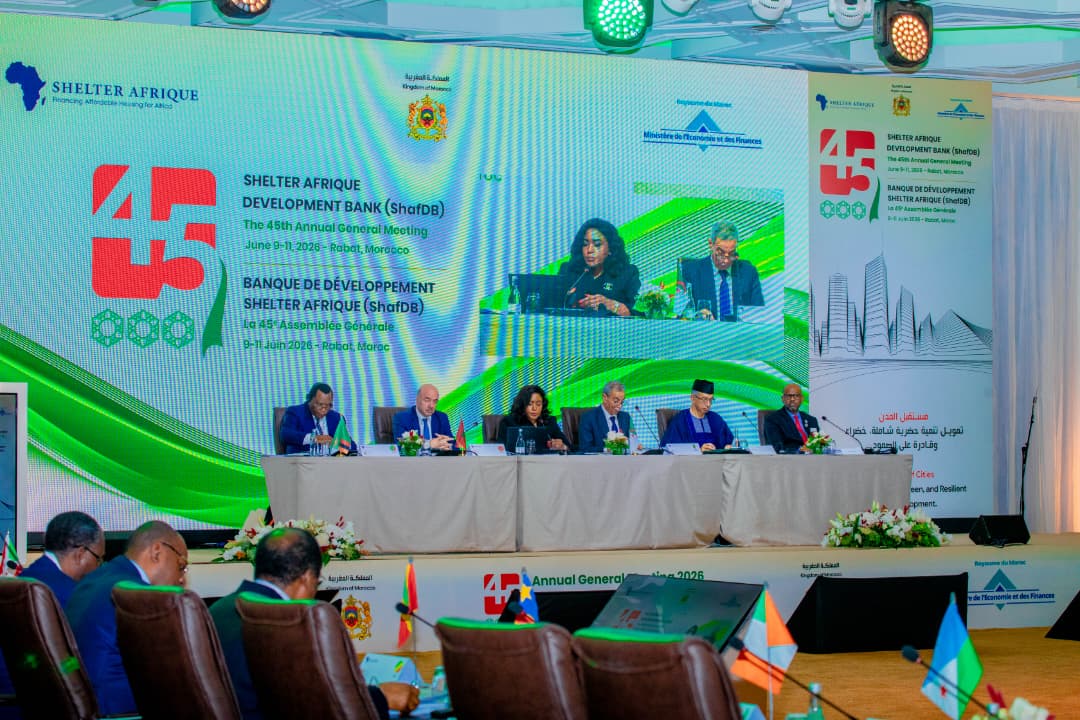
Shelter Afrique Development Bank reported a 20 percent increase in profitability in 2025 after sharply expanding lending activity and securing fresh funding lines, underscoring the lender’s transformation into a larger player in Africa’s housing and urban development finance market.
The Rabat-based institution posted comprehensive profit of $2.14 million for the year ended December 2025, up from $1.79 million a year earlier, driven by stronger loan growth, stable income from core operations and gains from treasury and investment activities.
The results come as Shelter Afrique seeks to reposition itself as a fully-fledged multilateral development bank focused on addressing Africa’s housing shortage, a challenge that continues to widen amid rapid urbanization across the continent.
Loan disbursements jumped 162 percent to $63 million from $24.1 million in 2024, helping expand the bank’s net loan portfolio by 29 percent to $174.1 million. Total assets increased 12 percent to $235 million, while shareholders’ funds rose to $176.1 million, supported by retained earnings and additional capital subscriptions.
“The Bank’s performance in 2025 reflects the successful execution of our transformation agenda and the strength of our governance, strategy and partnerships,” Board Chairman Lionel Zinsou said in a statement on Thursday.
A key milestone during the year was the securing of a $120 million concessional facility from the Arab Bank for Economic Development in Africa, or BADEA, under the institution’s capital increase program. The funding is expected to help member states regularize capital subscriptions while supporting Shelter Afrique’s ambition to secure an investment-grade credit rating.
The lender also mobilized an additional $50 million financing facility from Afreximbank, strengthening its capacity to fund affordable housing developments and urban infrastructure projects across Africa.
The funding agreements provide fresh momentum for an institution that has spent recent years rebuilding its balance sheet and broadening its funding sources after a period of operational restructuring.
Interest income remained broadly stable at $18.6 million, demonstrating resilience in the bank’s core lending business even as operating expenses rose amid institutional reforms and business expansion initiatives.
Chief Executive Officer Thierno-Habib Hann said the results marked an important step in the lender’s ambition to become Africa’s leading housing and urban development finance institution.
“We grew our loan portfolio by nearly 30 percent, strengthened our balance sheet and diversified our funding sources while maintaining profitability,” Hann said.
Beyond lending growth, Shelter Afrique accelerated efforts to deepen its capital markets activities and reduce currency risks that have historically constrained long-term infrastructure and housing finance across Africa.
The bank said it has developed the capability to structure synthetic local-currency financing solutions, allowing borrowers to better match debt obligations with local-currency revenue streams.
Preparations are also at an advanced stage for a CFA franc-denominated sustainable bond program worth 60 billion francs ($103 million) in West Africa, while approval has been secured for a $500 million East Africa Sustainable Bond Program.
The initiatives are expected to provide new sources of long-term funding and support the development of local capital markets, a priority for African policymakers seeking to reduce reliance on foreign-currency borrowing.
Africa faces one of the world’s largest housing deficits, with urban populations projected to expand rapidly over the coming decades. Development finance institutions have increasingly stepped up efforts to mobilize private and public capital into affordable housing, climate-resilient cities and urban infrastructure.
For Shelter Afrique, the challenge now will be converting its stronger balance sheet and growing funding pipeline into larger-scale investments capable of narrowing the continent’s housing gap while sustaining profitability.
The bank said it will continue expanding its funding base, strengthening local-currency financing capabilities and improving balance-sheet efficiency as it seeks to scale development impact across Africa.