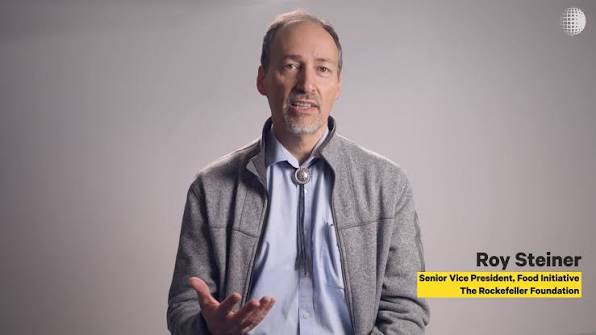
Africa must significantly increase public investment in agriculture and treat school feeding as a tool for economic development if the continent is to build more resilient food systems and reduce its dependence on imports, according to Roy Steiner, senior vice president of the Food Initiative at The Rockefeller Foundation.
African governments have historically underfunded agriculture despite its importance to economic growth and food security, Steiner said in an interview on the sidelines of The Africa Food Systems Forum.
“There is a gap, and this is a gap that has been for a very long time,” Steiner said. Agriculture remains “under invested in and under prioritized,” he said, adding that meaningful progress will require greater government focus and investment.
Steiner also called for closer coordination among governments, private companies, funders, researchers and other actors, arguing that transforming Africa’s food systems cannot be achieved through isolated interventions.
“These are system transformations that need to be taking in place and so you need to connect every part of the system,” he said.
School Meals as Economic Policy
The Rockefeller Foundation is increasingly positioning school meals not simply as a nutrition or education intervention, but as a mechanism for strengthening local food systems and creating markets for farmers.
Steiner pointed to Brazil as a leading example, saying the country’s school feeding program reaches about 40 million children while generating economic opportunities for small and medium-sized family farms.
Evidence from at least 15 countries shows significant returns from investing in school meals, he said. For every dollar governments invest, returns can range from $9 to $30, according to the research cited by Steiner.
The benefits extend beyond nutrition. School attendance can rise by as much as 30 percent, while better-fed children are better positioned to learn, he said.
School procurement can also create predictable demand for crops such as millet, sorghum and high-iron beans, giving farmers an incentive to produce more climate-resilient and nutritious food.
“You can talk all you want about climate resilient crops. But if you don’t have a demand for it, if farmers can’t sell it, they’re not going to grow it,” Steiner said.
Rwanda Offers a Model
Rwanda, where the government has expanded its school feeding program to millions of students, provides an example of how procurement and nutrition policies can reshape food systems, Steiner said.
He highlighted the country’s move toward fortified whole grains, arguing that reducing the processing of grains can simultaneously increase the amount of food available and preserve nutritional value.
By shifting away from refined grains, countries can retain significantly more of the original food and nutrition, Steiner said, citing potential gains of 20 percent to 30 percent in food supply.
He said Rwanda’s experience also demonstrates how government policy can create demand for healthier food while opening opportunities for local processors and farmers.
“There isn’t anything but you need government to say we’re going to do this,” Steiner said, describing Rwanda’s approach as an example of the kind of policy decision needed to transform food systems.
Philanthropy Can’t Replace Government
The Rockefeller Foundation has committed $100 million toward improving the availability of more nutritious school meals globally, while the financing needs across Africa are estimated in the billions of dollars.
Steiner said philanthropic funding can help catalyze change, but governments must ultimately carry the financial burden of school feeding.
More than 95 percent of school meals globally are already funded by governments, he said, making public financing central to the sustainability of such programs.
“School meals cannot be funded by anybody else,” Steiner said. “Feeding the children of the nation is the responsibility of the government and should be a priority expenditure.”
He also pointed to innovative financing mechanisms, including taxes on ultra-processed foods and sugary beverages, as potential sources of funding for healthier school meals.
Scaling Beyond Pilots
A major challenge for Africa will be moving successful food-system interventions from small pilots to programs capable of reaching millions of people.
The Rockefeller Foundation has helped establish a School Meals Accelerator, housed within the World Food Program, which Steiner said is designed to help governments improve the efficiency, transparency and accountability of their school-meal systems.
The initiative aims to help governments reduce waste, leakage and corruption while improving monitoring and ensuring that meals provide adequate nutrition.
The longer-term opportunity, Steiner said, is to use school meals as an anchor for a broader regenerative food economy.
In Rwanda, he highlighted the potential of centralized kitchens powered by solar energy, electric vehicles and local procurement from farmers. Such a model could create reliable demand for agricultural producers while encouraging investment across the supply chain.
“If you create anchor demand, you create demand that farmers can rely on year after year,” Steiner said. “That creates this really resilient supply chain.”
Such procurement could also favor regeneratively produced food, creating incentives for farming practices that improve soil health, preserve water quality and biodiversity, he said.
For Africa, Steiner said, the opportunity ultimately comes down to ensuring that farmers can build viable businesses and that governments recognize food systems as an economic priority.
“I love that phrase that the future of Africa depends on the future of its farmers,” Steiner said. “If we can ensure farmers are thriving, Africa will thrive.”